

This past week at the Association of the United States Army annual meeting, Sergeant Major of the Army Michael Weimer announced the upcoming formal adoption of a mountaineering badge for U.S. Army personnel. This moment acknowledged a long-lobbied for recognition of the unique skills embodied in the Military Mountaineering community. While detailing the badge, however, Weimer made clear that the badge adopted would be a new design, remarking “Who remembers the goat head for the mountain [badge], Yeah. that’s not going to be the badge.”[i] While soldiers echoed their excitement about the new badge, some saw the announcement as a rejection of the Ram’s Head Device and the storied traditions of mountaineering in the U.S. Army, and a rush to replace it with something new that had little basis in the legacy of Army Mountain Warfare. Because as it turns out, the Ram’s Head Device has its roots in the valor, tenacity, and heroism of the World War II generation.
Military mountaineering in the U.S. Army became famous in World War II with the 10th Mountain Division’s heavily publicized training and deployment to combat in Italy. Despite the dozens of articles, newsreels, and battlefield triumphs of the unit, the Army inactivated the 10th Mountain in 1945. While most of the veterans of the division filtered back to civilian society, several opted to remain in the military and steward the tradition of military mountaineering in Cold War era. In August of 1951 the Army formally established its first post-WWII Mountain Training Command, headquartered at Camp Carson, Colorado. [ii] Staffed by veterans of the 10th Mountain Division, like commander Lieut. Col. Donald Wooley, the school sought to transfer the lessons learned during the war to individual soldiers across many units. These Mountain instructors feared that without a dedicated mountain unit in the Army, the skills learned during World War II would soon be lost, and in the next war, the Army would have to completely retrain a force for mountain warfare.

It is in the mountains of Colorado that the Ram’s Head Device first made its appearance. The staff of the schoolhouse adopted a small badge to identify soldiers who had passed the rigorous course and excelled enough to become instructors. In a 1954 article in the Army’s monthly magazine titled, “They Wear the Golden Ram,” Lieut. Col. Wooley explained that members of his command, “may be recognized by the distinctive gold and silver emblem in the form of a Rocky Mountain bighorn ram… signifying that they are trained to operate in deep snow and mountainous terrain and to fight in small unit actions under adverse weather conditions.”[iii]

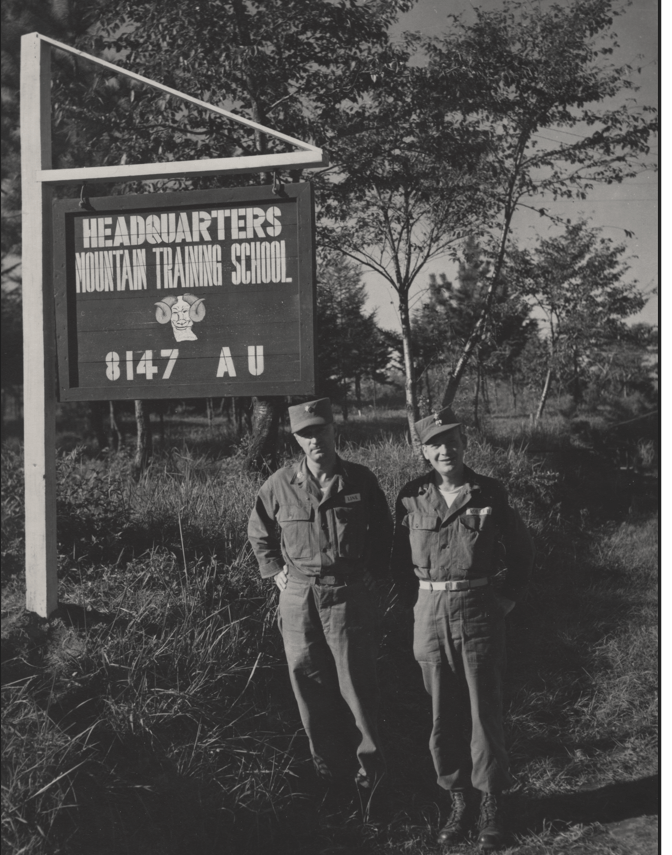
Wooley’s device did not just remain with the Carson School. As the war in Korea heated up, the Army established small provisional schools in Europe and Japan, and instructors at these courses also donned the Ram’s Head Device to mark their personnel as experts in military mountaineering. Lieut. Col. Ed Link, an American Alpine Club member and veteran of the 10th Mountain Division, headed up Army Unit 8147 in Honshu, Japan. The unit marked the entrance to their course with a large ram’s head insignia, and each instructor was awarded a Ram’s Head Device for wear on their headgear after completing certification.[iv]The insignia served as a way for these WWII mountain warfare veterans to carry on their legacy and memory.

Historian Lance Blyth, author of Ski, Climb, Fight: The 10th Mountain Division and the Rise of Mountain Warfare, found in his research that the ram’s head was soon incorporated into other Army insignia to denote a connection to mountain warfare. “With the activation of the MCWTC (Mountain and Cold Weather Training Command) in 1951, a new design was born… crossed skis, an ice axe, and coiled rope in the background with a ram’s head superimposed.” That same year, the U.S. Army approved the Distinctive Unit Insignia for the 85th Infantry Regiment, one of the former 10th Mountain elements still active in the Army. Its crest distinctly featured “the ram’s head symboliz(ing) a unit skilled in mountain activity” as a homage to its mountain past.[v] The ram’s head was everywhere in the U.S. Army where mountain warfare was taught. With the closure of the schools outside the continental U.S. and the transfer of the Mountain Program to Alaska, the use of the Ram’s Head Device itself soon fell out of practice, though it remained a part of heraldic designs across the Army.

The most recent chapter in the ram’s head’s history comes not from the Regular Army, but the Army National Guard. In 1983 the Vermont National Guard and several New England states received authorization to recruit and train a mountain infantry unit for the first time since World War II. They nicknamed it “The Mountain Battalion,” which was later designated the 3d Battalion 172d Infantry.[vi] To help build this capability, the Vermont National Guard also received authorization to establish a mountain warfare school at Jericho, Vermont’s Camp Ethan Allen, to train its own military mountaineers who didn’t necessarily come from a climbing or winter weather background.[vii] To pay homage to the previous generations, the school brought back the Ram’s Head Device, issuing it as a locally authorized badge worn by graduates within the mountain battalion.

Though first issued only to Vermont Guardsmen, with the transition of the school as the official “U.S. Army Mountain Warfare School” in 2003, graduates from all components, branches, and allied nations received the Ram’s Head Device upon completion of the Basic Military Mountaineer Course. It appears on a soldier’s Enlisted Record Brief/Officer Record Brief as a Vermont Army National Guard State Award and can be locally authorized for wear by commanders. In as many as 15 different States the Ram’s Head Device is authorized for wear by the Adjutant General, and its wear is unofficially permitted in countless other states, units, and commands.[viii] Across the generations, the legacy of the Army’s first mountain fighters lives on in the Ram’s Head Device.
Sergeant Major of the Army Wiemer’s announcement this past week marks a recognition of the importance of military mountaineering on the future battlefields in large-scale combat operations. The 10th Mountain Division has recently begun a return to its mountain roots focusing on climbing, skiing, and mountaineering missions and retaining “Echo qualified” soldiers.[ix] Since 1985, the Army National Guard has expanded its mountain capability to a full Infantry Brigade Combat Team, and the Mountain Warfare Schoolhouse recently completed a multi-million-dollar upgrade of their facility. As the Army refocuses on the importance of Mountain Warfare, it’s a great time to look back at its roots in our force. For almost seventy-five years, the ram’s head has been worn by the U.S. Army’s Military Mountaineers as a symbol of connectedness across the generations. Why change it now?

[i] Jeff Schogol, “Army announces ‘Master Combat Badge’ to combine CIB and EIB for infantry soldiers,” Task and Purpose, 15 October 2024, https://taskandpurpose.com/news/army-combines-eib-cib/
[ii] Unit Data Card, US Army Mountain and Cold Weather Training Command, TDA Files, Force Structure and Organizational History Division Collection, U.S. Army Center of Military History.
[iii] Donald Wooley, “They Wear the Golden Ram,” Army Information Digest, Vol 10, No 3, March 1955, 18.
[iv] Curry, Dodson Moore. Dodson Moore Curry Collection. 1952. Personal Narrative. https://www.loc.gov/item/afc2001001.11193/.
[v] Instagram Post by Historian Dr. Lance Blythe 17 October 2024; “Symbolism of the Crest of the 85th Infantry,” The Institute of Heraldry, https://tioh.army.mil/Catalog/HeraldryMulti.aspx?CategoryId=7962&grp=2&menu=Uniformed%20Services
[vi] Richard Andrews, “Major Hails Healing Process,” Rutland Daily Herald 12 November 1984, 5.
[vii] Andrea Herzberg, “New Guard Unit to be Based in Vermont,” The Rutland Daily Herald, 10 June 1982, 15.
[viii] Conversation with ARNG Training Division Staff 20 October 2024
[ix] Interview with MG Greg Anderson and CSM Nema Mobar, “The 10th, Then and Now,” Nintey-Pound Rucksack Podcast, 11 January 2024.
About the author: Aaron Heft is a historian, former infantryman, and concerned military mountaineer.
Cover image: AU 8147 Rams Head- “LTC Link (former 10th Mountain) and his XO MAJ Roberts (sporting a Ram’s Head on his patrol cap) stand by the newly erected sign for the Mountain Training School in Honshu, Japan , Authors Collection”
Enjoy what you just read? Please share across your social media networks

 The Angry Staff Officer
You must be logged in to post a comment.