

Editor’s Note: For most of us, military service provides little time for reflection. We’re so engaged that there are few times we sit back and think about what our service means, trends we have seen, and maybe some lessons observed. Mr. Steele’s retirement remarks resonated with me because he was able to encapsulate a lot of what many of us, I think, feel. And it might be good to read these things now, rather than when we retire.
For a little context, I served 21 and a half years, give or take, in the Washington Army National Guard. Between training, deployments, active duty for operational support (ADOS), and Active Guard Reserve (AGR) time, all but about 11 months of that were on active duty. For most of my career, I was blessed to be in the 341st Military Intelligence Battalion (Linguist), though I also spent some time in the 81st Brigade Combat Team (Stryker), which had its moments.
What follows are the prepared remarks from my retirement ceremony on August 4th, 2024 (i.e. Sunday of drill weekend). I went off-script a fair bit, and while I have tweaked these to include a few of those points, I omitted any mention of individuals or specific identifying details, as theirs are not my stories to tell. I retired effective 1 October.
Thank you for being here with us. I’m going to try to mostly stay on script just this once, so we can finish at a reasonable hour.
Please take a moment to really look around the room. This is the largest group of people favorably disposed to me that has ever gathered, and likely the largest that ever will, except for perhaps at my funeral. It’s not THAT big a space, but I have always preferred quality over quantity in my associates, and I commend you for your excellent judgment in choosing to be here–or your commander’s judgment, if you were ordered to be here.
I must admit that I was strongly tempted to go with “remarks complete”1 and sit down again, but I’m keenly aware that this is likely the last time that anyone here except perhaps my family must pretend to listen to me, so I should make the most of this opportunity. Some of you have had to listen to me for a very long time and will have heard much of this before; some of you haven’t ever had to listen to me. I’m not sure who will find this harder to bear.
Lessons learned
A few lessons learned–or at least lessons observed–follow. Learning implies that behavior changes as a result. Perhaps you can do better at this than I did
- Clever vs. Kind. I’m a reasonably clever person; I have not always been a kind person. I spent way too much of my life trying to be clever, and not nearly enough trying to be kind. The latter is rarer and will last a lot longer, and you can still aspire to be the kindest person in a room years after you’ve given up trying to be the cleverest. (Clearly, I am not there, but in my defense, I’ve come an awfully long way from where I started.)
- Accountability must work in all directions. Holding subordinates accountable is easy; holding your leaders and your peers accountable is harder, but critical. They should know that you expect them to have the highest standards, and they should hear about it (politely) when they don’t. When you are in charge of a good team, they set the expectations for you at least as much as you set the expectations for them. I recently fulfilled a long-time wish when I entirely skipped the first PT2 formation to go out for breakfast, something I’d never done before in my whole career. I was more than a little sad that no one called to check on me. Later, I learned my absence was noticed, but no one felt they had the authority to call me out on it, so I had some discussions with the relevant people. It was a good breakfast, but a better teaching point, I hope. Holding your leaders accountable, perhaps by asking the hard questions in the meetings, tells them what your expectations and needs are and helps keep them on the straight and narrow. When as a leader you don’t get any feedback, it’s very easy to wander far afield. Everyone, especially a warrant, needs someone to hold them accountable.
- Be who we say we are. The hardest times to serve have been when there was a large gap between who we say we are–our mission statements, our Army values, etc.–and who we actually are. We do moral injury to soldiers when we tell them we operate according to certain professional values and principles, and teach them that those are right and proper, and then they see us fail to actually act that way. I have felt betrayed a few times by my leaders over the years, and it became impossible to trust them again and very difficult to trust even their successors. The times when I know I have fallen short bother me; what bother me more are the times that maybe I didn’t even realize I was failing the people under me. Or I didn’t do the thing I was supposed to do, and they were damaged by that, and their faith in the institution or organization was damaged, and I don’t know about it because I didn’t even notice how badly I failed. If I was ever that person for you, I’m sorry. I tried, but maybe not as hard as I should have.
- They can’t say no if you don’t ask. There are at least two valid ways to read this, and knowing when either is appropriate can be a trick.
- The “you miss all of the shots you don’t take” sense. They just might say yes and there’s only one way to find out. Shoot for the moon; you might get a weather satellite.
- The “what they don’t know won’t hurt them” sense. Sometimes it’s best not to bother the boss with a question that would only cause friction, delay, or stress before they finally come around to what you needed in the first place. If you look sideways and squint, this is “disciplined initiative.”3 You must decide whether it’s worth the risk.
- Rank is a tool, not a measure of value. Only you get to decide what matters to you, and especially in the reserve component where most of us have real jobs and real lives, rank is a silly way to measure value. Higher ranked people are not necessarily more valuable than you–they’re just more expensive. Your rank is not there to inflict your idiosyncrasies on your subordinates, but to enable you to protect their welfare and to accomplish the mission4.
I enlisted in early 2003, into this very company, intending to get a) continuous employment until the economy recovered and b) a security clearance that I could use to find easy yet lucrative contract IT work for the Department of Defense. I got the continuous employment and the clearance; I never went back to IT work. I never went back to the civilian world at all; in the 21 and a half years I’ve been in, less than 12 months were one-weekend-a-month, most of that before I shipped for Basic or in between initial entry training and my first deployment. They kept giving me wars or other interesting things to do, and I kept choosing to do them. Now I’m choosing something else.
Reasons for getting out
I declined consideration for promotion to Chief Warrant Officer 3, instead choosing to retire, as I was unwilling to commit to another three years. I have a few reasons for stopping now.
- I’m excess to needs of the Army. Unlike everyone else in the entire Army system, we have more than enough warrants, many of them with much more recent experience doing the job. I’m proud to say that I helped train some of them, but they have gone farther than I ever will, which is as it should be. My spot won’t even get cold before I am replaced; I am literally holding up other people’s career progression by staying any longer. I do not add anything professionally that you can’t get elsewhere and for cheaper from someone who has a future in the Army.
- I want my time back. I’ve been married 24 years; between training, TDYs5, and deployments, we’ve been together for perhaps 20 of those. As my family and I get older, I am less willing to accept commitments that will take me away from them. I want to make better use of my time for our own purposes.
- My military bearing has burned out. I’m not very ‘military’; it’s just something I have been doing for a long time, and I’ve loved doing it, but I’d like to stop now. I don’t actually believe anyone outranks me, except in very narrow and artificial circumstances necessary to function in this very specific context. It’s really useful for wartime. I don’t like calling people ‘sir’ or ‘ma’am’ (lest they start to believe it), and I don’t like being called ‘sir’ (lest I start to believe it).6 Saluting outside of ceremonial occasions is stupid. Being a warrant officer is as close as I can get in the military to being me, but it’s not close enough for my taste.
- I don’t want to kill anyone else. My first deployment in 2006 was to provide tactical intelligence support to infantry and SF dudebros in Afghanistan. I may have killed some people with a light machine gun; I was certainly trying to. My second deployment, ten years later, was to Qatar and Kuwait to provide intelligence support to targeting, helping generals to decide where to drop bombs against ISIS. I’ll never know exactly how many people I helped kill, but it was quite a few. I was exceptionally good at that mission; I don’t wish to ever do anything like it again. When you are in uniform and they call, you answer. They may have to call someone, but I have come to realize that I really don’t want them to call me any more.
Concluding remarks
I have the utmost respect for the people who came before and trained me, and the people who have followed in my wake and will have to carry on the important work of the Army, but I no longer wish to be part of this process. The Army keeps rolling along–it’s in the song and everything. It can roll along just fine without me, but with my fond hopes and prayers for those of you who keep it rolling.
Because I have a poor memory, I keep a note app on my phone with a frequently-updated list of “things I hate about the Army.” I expect in a few years I will start to reminisce and think about all of the good parts of being in uniform–most of them in this room right now–and I will forget the bad parts. The list is to remind me why I am happy to get out so I don’t become one of those old guys with a bad hat talking about how great the Army was to all of the other people in the restaurant.
I won’t need reminders about the good parts; you may rest assured I will be thinking about you all often.
This concludes my prepared remarks. What are your questions? [time for questions]
[to reviewing officer] Sir, I have fulfilled my obligations to the Army. May I please be retired now?
Footnotes
- In rehearsals for ceremonies, whomever is speechifying will walk up to the mic, say “remarks complete” and they will move on to the next part, rather than actually make whatever speech is supposed to happen. As with gases in chemistry class, military ceremony rehearsals will always expand to fill all available space. ↩︎
- physical training, i.e. what the rest of the planet calls “exercise” but together as a group. It is more about building the team through shared suffering than it is about fitness. ↩︎
- Disciplined initiative is one of the principles of the Army’s mission command philosophy. ↩︎
- Turns out I was inadvertently channeling Gen. Bruce C. Clarke, more fully quoted: “Rank is given you to enable you to better serve those above and below you. It is not given for you to practice your idiosyncrasies.” ↩︎
- I think of it as “temporary duty yonder” but I’m not sure this acronym actually breaks out into anything meaningfully. Temporary work travel. ↩︎
- So yeah, moving to the Tennessee part of the country probably wasn’t the best plan if this sort of thing bothers me. But compromise is often necessary. ↩︎
Afterward
I am living happily ever after in the greater Nashville area, learning studio engineering on my GI Bill and playing bass guitar an awful lot. In the wake of my retirement remarks, a lot of soldiers asked me for the mentioned list of things I hate about the Army, but I refused to share it with anyone with less than 15 years time in service; those people need to make that particular voyage of discovery on their own. (The more senior people who asked just wanted to compare notes and make sure I didn’t forget anything.)
I have stupid Army dreams all of the time. Last night I was senior rater for a sergeant I’d never met and the rating staff sergeant gave me the NCOER but it was written on a developmental counseling form from 1995 and it basically just said “I wish he weren’t a liar” and nothing else and I was running around the building trying to find this guy so I could help him write an actual eval on the right form but recruiting command was there with cameras interviewing soldiers and I was trying to avoid them. Also, my sergeant major and my old first sergeant were there and they kept trying to ask me to senior rate more people I didn’t know.
Enjoyed what you just read? Please share via social media, email, heliograph, etc.
About the author: Ben Steele is a student human, musician, and aspiring audio engineer in the greater Nashville area. These remarks were originally shared on his personal web site at soundslike.pro, where he writes semi-regularly about audio, independent social media, and interesting problems and solutions therein.
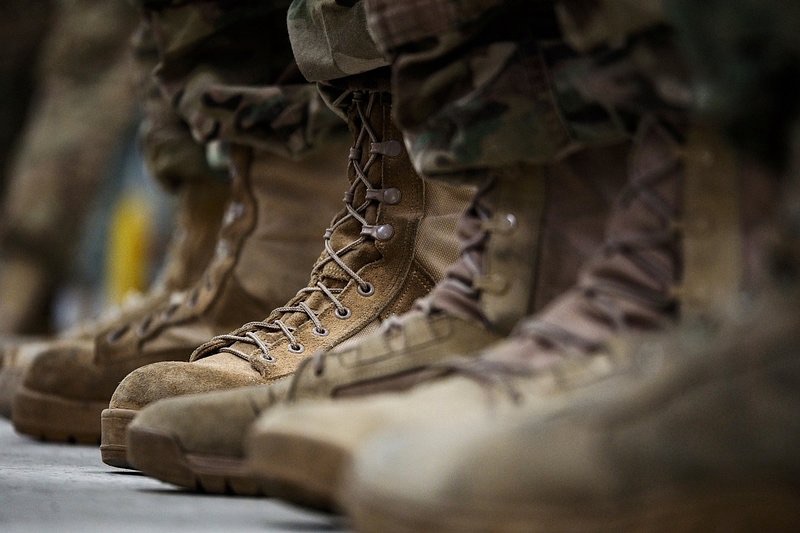
Cover photo: Soldiers assigned to the 17th Combat Sustainment Support Battalion, U.S. Army Alaska, stand at the position of attention during a formation. (U.S. Air Force photo/Justin Connaher)

 The Angry Staff Officer