

In a recent prepared statement by Secretary of War Pete Hegseth in which he cut the War Department’s ties and affiliation with his alma mater, Harvard University, he made several references that should make all American citizens—especially those in uniform—cringe with concern. His assertion that for decades the U.S. military sent its “best and brightest” officers to Harvard and other Ivy League universities “in hopes [those universities] might better understand and appreciate our warrior class” is not only incorrect on its face (that’s never been the intent of sending officers to graduate school), but it also espouses a class-based view of America’s military which runs completely contrary to our Republic’s military tradition and heritage. Sec. Hegseth even cited Washington’s assumption of command of the Continental Army in Harvard Yard in 1775 to impress upon his audience just how far Harvard and other universities had strayed from supporting their military. This follows several books and months of official statements where Sec. Hegseth touts his ‘restoration of the warrior ethos,’ his focus on ‘lethality’ and combat effectiveness, and his war on the ever nebulous ‘wokeness’ he claims has infected our military.
There is pungent irony in the Secretary’s decision to invoke Washington’s legacy in that statement. While on the way to Cambridge to assume the unimaginably heavy responsibility of commanding the new Continental Army in June of 1775, Washington stopped in New York City to deliver an address to the New York Provincial Congress. Though characteristically brief, humble, and temperate in his words, the 43-year-old General Washington made one salient pledge to the gathered audience that day. “When we assumed the Soldier, we did not lay aside the Citizen,” he said, as he assured the legislators gathered there that this army of citizen soldiers would not become an instrument of state power over its own people. “Warrior” and “warrior ethos” were words Washington never used when describing what he aspired to or what he wanted his Army to emulate, and in fact you would be hard pressed to find any examples of his use of those words. Washington and most of the other founders would be appalled at the casual suggestion of the existence of any “warrior class” within American society—a society whose military heritage emphasizes that our own citizen-soldiers fight our wars, and not some detached “warrior class.”
The same is true of “lethality.” When we look at the history of America’s military, we find that this “restoration of the warrior ethos” and focus on “lethality” Sec. Hegseth incessantly speaks of is more a product of his limited military experience, his imagination, and his personal insecurities than anything anchored in our history or traditions. Washington worked tirelessly to build what he called a “respectable army,” and while direct lethal action is obviously an inherent and unfortunate reality of war, it was never the focal point of the meaning of military service in the Continental Army. Later in our history, the soldiers and officers who fought and won the Civil War once again broadly aspired to a tradition of volunteer citizen-soldiers, setting down their figurative (or in many cases very real) plows when duty called upon them, only to return to those plows when hostilities ceased. America’s senior military leaders historically leaned into this tradition, and avoided pandering to the false bravado of self-aggrandizing, macho, “warriors” standing ready to inflict maximum “lethality.” That model runs against the heritage and tradition of the American citizen-soldier and effectively exacerbates the problem of the increasingly cloistered warrior class—a condition which Sec. Hegseth seems happy to embrace rather than attempt to mend.
Incidentally, investigating the Secretary’s “restoration” might leave many disappointed to discover the ancient origins of the Army’s warrior ethos, which is unimpressively 23 years old, or 27 years if we’re generous. That “ethos” was formally adopted in 2003—while the Department of Defense was launching major ill-fated combat operations in the Middle East oriented on the vaguest strategic ends imaginable, and which culminated two decades later with the fall of Kabul. Is that the historical period, culture, and heritage Secretary Hegseth is “restoring?” If so, it reveals his puddle-deep appreciation for the 250-year history of the Army and its sister services, and his inability to put his own military service in context. American history was forged not by “warriors” or “lethality,” but by soldiers who were citizens—family members, laborers, teachers, tradesmen, etc.—first and foremost, and who reluctantly agreed to engage in the horrors of war only when all other means failed to avoid that recourse. The wisdom of our nation’s founders that Sec. Hegseth would gain much from in his current role is that reliance on citizen-soldiers—not warriors—tends to steer free societies toward restraint and painful deliberation over the use of military force. What ought to be restored is that citizens themselves should bear the burdens of our wars, and precisely NOT a bought and paid for “warrior class” which may indeed fight well but effectively insulates the citizenry from the horrible realities of combat resulting from policy decisions—realities which elected leaders in recent decades seem all too comfortable accepting in the name of political and economic expediency.
In his famous “Duty, Honor, Country” speech, Douglas MacArthur never used the terms “warrior” or “lethality.” But he did say “The soldier above all others prays for peace, for it is the soldier who must suffer and bear the deepest wounds and scars of war.” If Secretary Hegseth wants to restore something meaningful, perhaps he should consider the citizen-soldier as a much more worthy and less arrogant goal—and one based on America’s real military heritage which once at least aspired to restraint, just causes, and duty performed despite the obvious calamity of battlefield lethality. American soldiers should not shape their identity based on warrior machismo nonsense, but something much higher than that. We American soldiers are not thugs pursuing accolades, wealth, and personal glory. We volunteer to bear the burden of executing the warrior’s craft when the absolute necessity to do so arises, and we trust that our elected AND unelected leadership take the cost of that burden into full consideration before they decide to send us forward. American soldiers must always be citizens first, and soldiers second—and certainly not a warrior class.
–Regulus
Regulus is a career Army officer and West Point graduate. He has served one combat deployment in Kunar, Afghanistan, and led soldiers as a platoon leader and two-time troop commander in the 101st Airborne and 4th Infantry Divisions. He is also a historian and is currently earning his spurs as an angry staff officer.
The opinions noted here are the author’s and do not reflect those of the US Army or Department of Defense.
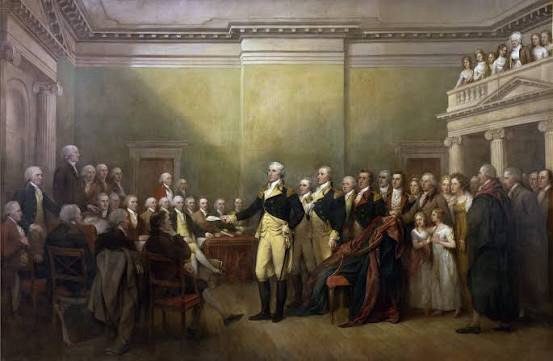
Cover image: Washington resigns his commission, by John Trumbull (courtesy Wikimedia commons)


