
Army leadership is based on principled discipline. Officers and NCOs each contribute to the maintenance and to the efficacy of the organization in different ways (NCOs own the discipline part, officers the principle). The contribution of each is made according to well-understood and internalized principles. For the most part, these principles do not need to be articulated…but they can be. The Army Values (Loyalty, Duty, Respect, Selfless Service, Honor, Integrity, and Personal Courage) provide the baseline guidance for all Army personnel. The Army’s leadership manuals (currently ADP 6-22, change 2, 06 February 2025, and FM 6-22, change 2, 20 February 2025) flesh out these principles that govern leadership in our profession in greater detail. Sum it up in a sentence? The introduction to ADP 6-22 tell us that “[a]n ideal Army leader serves as a role model through strong intellect, physical presence, professional competence, and moral character.” Further, we learn that “it is the American people’s trust and confidence in the Army as an ethical profession that grants it the autonomy to exercise the disciplined initiative critical to accomplishing missions” (emphasis added).
Awkwardly, the current federal administration has shown itself to be indifferent to the principled constraints to which the executive branch of government has traditionally been subject. This may not be the place to convince those that fail to perceive (or refuse to acknowledge) this development. That said, based not only on the administration’s behavior but on its own statements, it has become clear that the constraints posed by international law and domestic law, hostility to oversight by the federal judiciary and Congress, as well the basic norms of civilization, are only acknowledged by this administration in some tenuous way. Instead, the administration seems to subscribe to some combination of absolute power politics (of the “strong do what they can and the weak suffer what they must” variety) in both domestic and international affairs, combined with an emphasis on loyalty over principle.
This leads to an obvious conundrum for leaders in the Army: how does one square this circle? To put the matter more precisely: in circumstances where the American people have elected this type of regime with their eyes wide open (given the President’s election to a second term in 2024), how do Army leaders reconcile the principled leadership required by the service with the American people’s embrace of an executive with a much more absolutist bent?
Kori Schake’s 2025 The State and the Soldier provides a comprehensive historical overview of the ways in which the American military has traditionally constrained itself within the American political structure. She marvels at the exceptional and unprecedented level of deference that the American military pays to the nation’s civilian leadership. For this she largely credits the personal example of George Washington who, despite his enormous popularity as America’s wartime general, always deferred in matters of military financing and strategy to the Continental Congress. From his example, Schake tells us, we have obtained the bedrock principles that have kept us from experiencing the military coups and related instability experienced by many other nations: a military that owes their loyalty to the Constitution, accepts subordination to both the President as commander-in-chief and to the Congress, and either faithfully carries out civilian dictates or resigns.
Present day military officers will also be familiar with the Uniform Code of Military Justice’s Article 88. It prohibits the use of “contemptuous words against the President, the Vice President, Congress, the Secretary of Defense, the Secretary of a military department, the Secretary of Homeland Security, or the Governor or legislature of any State, Commonwealth, or possession in which he is on duty or present.”
So, it is clear that senior military leaders are prohibited by law and by powerful institutional norms, both from using military forces in a manner that the civilian leadership disagrees with—say, in the most extreme example, to perpetrate a coup—and are equally prohibited from insulting the person of the President, the Secretary of Defense, and certain other individuals. The UCMJ’s “general article”, prohibiting “[t]hough not specifically mentioned in this chapter, all disorders and neglects to the prejudice of good order and discipline in the armed forces [and] all conduct of a nature to bring discredit upon the armed forces” provides slightly less concrete guidance, but can be easily and usefully contextualized by all we know about Army leadership and how it is defined.
More interesting, perhaps, is what is not prohibited. Despite George Washington’s powerful example of military subordination—an inheritance that has bequeathed America an exceptional resilience from direct military influence in domestic political affairs—Schake points out that even Washington gave “his views on national matters while in uniform.”
Our leadership doctrine positively requires principled, ethical, and moral leadership. Our deference to the civilians is wide-ranging, but apparently does not include an obligation to be silent. Most importantly, our loyalty to the Constitution cannot entail a duty of intellectual subordination to the Department civilians and the White House.
At some level, we have always known this; principled leadership has always included principled dissent. Indeed, how could the requirement that military leaders provide their best professional military advice to civilian leaders co-exist with a requirement to accept the pronouncements and logic, however flawed, that the civilian leaders adopt? It cannot. Intellectual, moral, and ethical rigor is the only way Army leaders can continue to fulfill their obligations. Willful blindness or a willingness to accept limits on intellectual enquiry may please the civilian leadership in the Department of Defense, but, as they say, it is no way to run a railroad.
Intellectual rigor requires that we, as a profession, maintain a space for unvarnished and unafraid professional discussions. As to where those discussions lead, the answer is obvious: the Army must continue to fulfill its non-negotiable contract with the American people, while maintaining the appropriate level of subordination to America’s elected representatives, without sacrificing its allegiance to Constitutional government. Not simple, but necessary. On the one hand, the military’s DNA is wholly antithetical to being the mechanism for replacing and opposing elected government, but, on the other, the military is equally unable to become the Order 66 crowd, executing orders that overturn the lawful system of government we have sworn to uphold.
This balancing act may require a great deal of tactical patience, a profound understanding and appreciation for uncrossable red lines, and an iron will to maintain professional standards while allowing the nation to find its way forward.
Garri Benjamin Hendell is a lieutenant colonel in the Pennsylvania Army National Guard. He has served three overseas deployments to the CENTCOM AOR, various training deployments to Europe, and served in 2022-2023 as the brigade task force S3 responsible for land forces in support of border operations. He is currently assigned to the planning staff in the 28th Infantry Division and serves as the Division Innovation Officer.
The views reflected here are those of the author and do not represent the Army, Army National Guard, or Department of Defense.
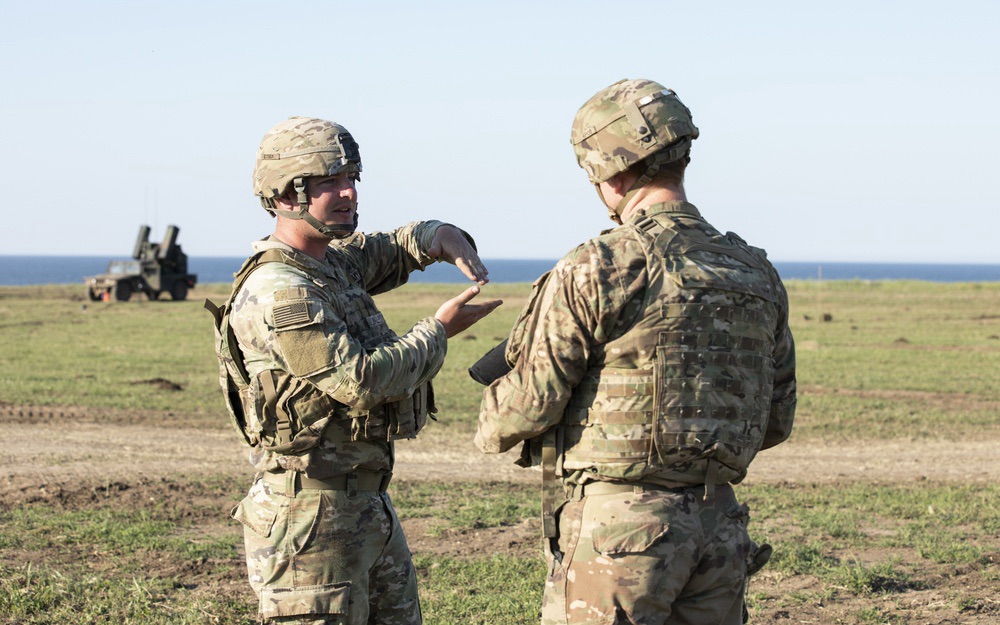
Cover image: 5-4 ADAR Soldiers talk after a LFX in Bulgaria, photo by Staff Sgt. Michael Gresso


