
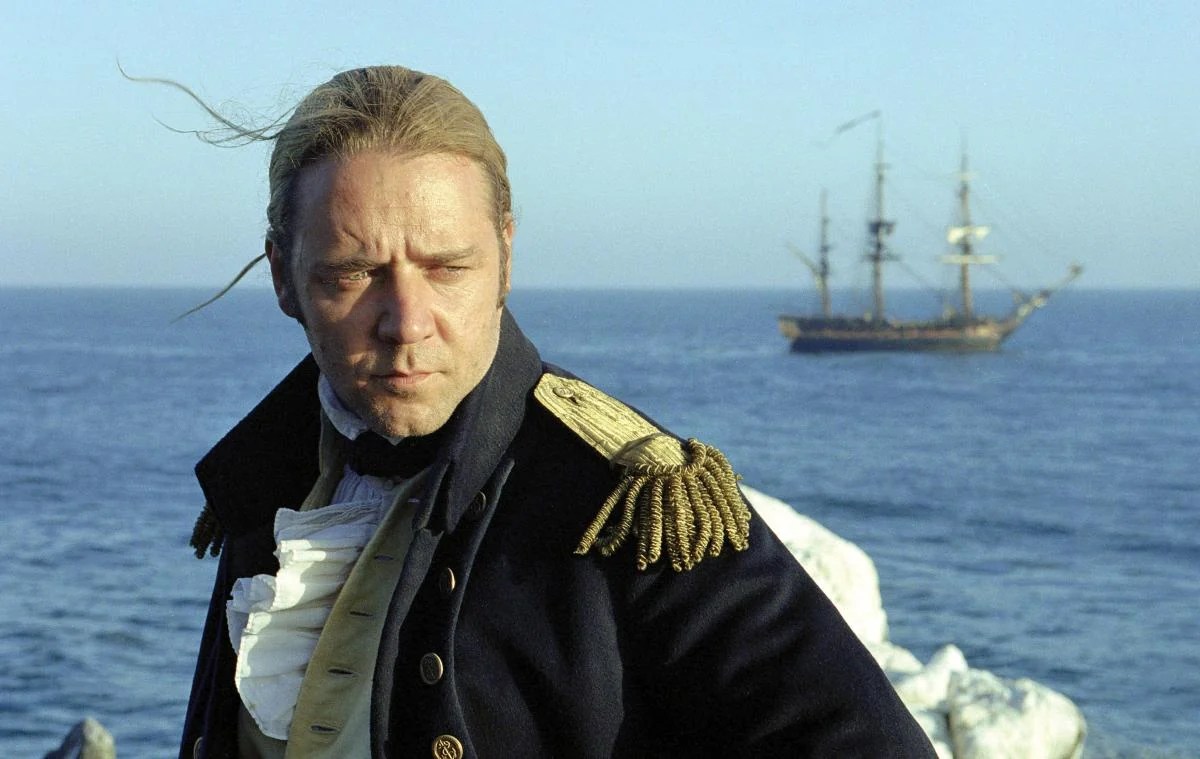
Leadership is an oft-discussed subject, especially within militaries. We’re always hunting for great leaders to emulate – and poor leaders to avoid emulating. Fiction offers myriad examples of both, and one of the all-time greats is Captain Jack Aubrey. He is one of two titular characters in the Aubrey-Maturin novel series by Patrick O’Brian, loosely based on the real-life Lord Thomas Cochrane, but he’s most well-known from Russell Crowe’s portrayal in the excellent adaptation Master and Commander: The Far Side of the World (dir. Peter Weir, 2003). The film tells the story of Royal Navy vessel HMS Surprise and her crew, who have been ordered to hunt the French privateer Acheron who is sailing from the Atlantic to the Pacfic to disrupt British trade during the Napoleonic Wars. It opens with:
April – 1805
Napoleon is master of Europe
Only the British fleet stands before him
Oceans are now battlefields
Which sets the stakes high for the 197 souls aboard Surprise, and it’s ‘Lucky’ Jack’s heavy responsibility to lead his crew to mission success. So why is he a great leader? The reference will be the ten principles of leadership in Australian Defence Force Leadership doctrine (ADF-P-0 ADF Leadership).
Know Yourself and Seek Self-Improvement
During an exchange with the ship’s doctor & naturalist, and his friend, Stephen Maturin, Jack learns about an insect which disguises itself to confuse prey. He connects this disparate piece of information with his current predicament about how to defeat the stronger Acheron and it forms the genesis of his battle plan.
Be Proficient
After a lifetime in the Navy, Jack is master of his craft. During the initial engagement where Surprise is ironically taken by surprise and receives a beating from Acheron, he doesn’t panic; he conducts sound terrain analysis and orders Surprise into the fog for concealment. Later when being pursued, he employs deception by deploying a decoy which leads Acheron away so Surprise can get behind. The ship’s master, Mr. Allen, remarks:
That’s seamanship Mister Pullings, my God that’s seamanship
Seek and Accept Responsibility
After sailing further south than Brazil, Jack has exceeded his orders. As a good officer, he understands their intent and why stopping Acheron is important to British interests and decides to continue pursuing. There is however, an element of hubris. It results in the loss of two crew members and after Maturin’s life is at risk, he admits that he has sacrificed too much for the sake of his pride, so decides to sail to the Galapagos Islands to save Maturin, and then return home to England.
Lead by Example
While pursuing Acheron around Cape Horn, a mast breaks and falls overboard while still attached. It’s dragging the ship down but the crew member Worley went overboard with it and he needs it to climb back onboard. Jack decides to save the ship and crew by cutting the wreckage free, condemning Worley to his death. Jack takes an axe himself and cuts the ropes with Worley’s best mate, Nagle. He shares the burden of this action with the sailor he commands to do it.
Provide Direction and Keep Your Team Informed
Jack hosts regular dinners with his officers. He uses these gatherings to share his plans, his thought process, and reflections on past actions. These aren’t just a social activity, they support his subordinates in understanding how their captain thinks so they can better carry out his intent.
Know and Care for Your Subordinates
There are numerous occasions where Jack checks, and improves, the well-being of his subordinates. There is one brief moment however, where during the first battle he sees somebody cowering. He pauses to pull the young midshipman up and deliver the best line of the film:
We stand tall on the quarter deck son – all of us.
Develop the Potential of Your Subordinates
There are two talented midshipman aboard who Jack mentors and subordinates much responsibility on them. As part of the decoy plan, Peter Calamy is delegated to board the raft to set its lanterns while under cannon fire. Later, during the final battle, Calamy is given the responsibility to find and free the captured whalers to join the battle and turn the tide in favour of the British. This task costs him his life which weighs heavily on Jack. During the same battle, command of Surprise is left with William Blakeney while the majority of the crew board Acheron. After Blakeney sees the French try to sink Surprise, he feels empowered to board to thwart them.
Make Sound and Timely Decisions
While pursuing Acheron around Cape Horn, Carpenter Lamb advises Jack that a mast may not withstand the storm. Jack acknowledges but decides to continue pursuing. This was the wrong decision: the mast breaks, pursuit is lost, and a sailor loses their life. Despite this, he didn’t hesitate to perform the most important function of a leader: he made a decision.
Build the Team and Challenge its Abilities
He creates opportunities to train his team but doesn’t drive them arbitrarily. Before departing the Galapagos Islands, the crew conduct gunnery drills. After taking two minutes and one second to fire two broadsides he explains why that’s insufficient, what the standard is, and says some inspiring words. The crew repeat the drill, achieve the target of one minute and ten seconds, and are rewarded with an extra booze ration.
Communicate Effectively
Before the final battle he delivers a set of orders which provide a clear understanding of the plan and how each component supports the others. These are delivered to the entire crew, so every hand is clear on what they need to do and how they can support the other teams.
Captain Jack Aubrey is a leader with many examples to follow. To quote Harvey Keitel’s Chief Clough from another naval film, U-571 (dir. Jonathan Mostow, 2000):
This is the navy, where a commanding officer is a mighty and terrible thing… a man to be feared and respected. All knowing, all powerful.
Jack is certainly that.
About the Author: Nicholas Clippingdale is an infantry officer in the Australian Army Reserve. He works in the energy industry in his day job.


