


By Sergeant M
Once you graduate from your initial technical school training, you take a final look out the rearview mirror and confidently state “I’m never coming back here again.” Until you come back seven years later for a course taken en route as a requirement for your next assignment……and you find yourself right back where you started. As much as the course taught me technically, it also taught me several important lessons about being a non-commissioned officer, more so than Airman Leadership School or any other supervisory experience.
1. The generation gap is real, but that doesn’t mean we can’t coexist
I was approximately 10 years older than the youngest student in my course. One student can’t even party like it’s 1999, because he was yet to be born. These students read about the attacks on the Twin Towers in their high school history books. One student blatantly told me we “didn’t have anything in common” and I then made it my mission to prove to him that even if we didn’t have anything in common, we could still coexist. Yes, I’ve never played a video game, but if you are proud of that killstreak, then I’ll be happy for you. A meme I don’t understand? I’ll look it up so I have some context. No, I can’t remember Toy Story quotes anymore, just as my Ferris Bueller quotes don’t relate to you. But that’s okay, because we’re
learning from each other.
2. You don’t know what you don’t know
It was interesting (and admittedly comical) to be surrounded by a fresh canvas of Airmen, longing for the ways of the operational Air Force to soon be impressed upon them. New Airmen are inquisitive, and fortunately, the small classroom environment left room for a lot of informal mentorship opportunities. Though dorm lawyers are alive and well and “my friend told me” still infiltrates the knowledge our Airmen are receiving, it was important to remember that once I didn’t know either, and I needed to rely on trusted sources to gain access to my information. Therefore, I found it incredibly important, and almost an honor, to ensure that these young Airmen were receiving proper information and not just hearsay. But I also deliberately showed and shared resources, so they could learn to seek out answers on their own. These ideas and techniques sound, frankly basic, and potentially patronizing, but until a tech school student asks you if you are allowed to eat in the DFAC after you become an NCO, you realize you don’t know what you don’t know, and it’s important to help our young Airmen gain useful knowledge.
3. Leadership by walking isn’t just for commanders
I learned about this concept at my last base. I enjoyed the opportunity to walk and talk one on one as my CC went to and from various meetings. I know she enjoyed the opportunity to engage with her squadron in this way as well. I’ve engaged in many random, yet hopefully meaningful walks from our schoolhouse to the dining facility. I’ve been asked my career goals, what the role of a technical sergeant is (spoiler, I’m making it up as I go along, no matter what a little brown book says!), how credit cards work, and how to navigate baggage claim at the airport. I don’t think I’ve offered any life changing advice or wisdom, but a one on one walk away from the stress of the classroom or the noise of the dining facility during lunch hour can make a difference. Though you might walk and talk – when people are heard and understood, – that’s when leadership is exhibited.
4. Use your positional power (rank) for good
When I started this class, each of the students was about six weeks out from their RNLTD. None had orders, and were attempting to set up RAP (recruiter’s assistance), but what was more concerning is that despite persistent questioning, they weren’t getting the information they needed to fulfill a requirement. Let me be clear, I don’t feel particularly powerful as a technical sergeant, but I know enough that if necessary, I can call upon the fine young SrA or SSgt who needs to help my Amn out, and get them to assist. Not in an abuse of authority way, but in a confident, “let’s get shit done” way. And as a byproduct, hopefully my verbal messaging (if I’m your supervisor, I work for you) coincides with my action and willingness to get results. On a somewhat related issue, because I was an NCO on a technical training base, everywhere I’d walk I’d get “good day sergeant, etc.” Don’t be rude and don’t respond. Say hello back, tell troops to have a good weekend. Respond with politeness and humanity, not arrogance and the aura that you are too good to engage in pleasantries. Set the tone that you are a person who cares about others.
5. Sharing is caring
I’m not talking about sharing a package of Oreos, though that definitely helps to break the awkwardness of the first few days. Sharing experiences is important. Sharing that you’ve failed is important, especially when a concept is frustrating. Sharing in the struggle is important. Sharing the gift of time and presence to support an Amn worried about their PT tests is important. You can share in many ways, but each shows you give a damn, and that is huge.
These seem like really basic lessons. They have been discussed in professional military education before. However, until you are confronted with a situation where you are the sole leader (aside from instructors) who is followed, the reverence of supervision cannot be fully understood. This was an experience. I know I wasn’t the “perfect” leader. There were probably comments I shouldn’t have laughed at, or maybe I should have interjected in classroom banter a bit sooner, but one thing I know I didn’t fail at was ensuring questions were getting answers.
I was asked, “Sgt M, aren’t you annoyed with all of these questions” And I said no, and quoted Colin Powell, citing “Leadership is solving problems. The day soldiers stop bringing you their problems is the day you have stopped leading them. They have either lost confidence that you can help or concluded you do not care. Either case is a failure of leadership.”
For now they’re still asking questions, so it doesn’t look like I failed leadership or technical training this time around.
About the Author: Sergeant M is an NCO in the U.S. Air Force
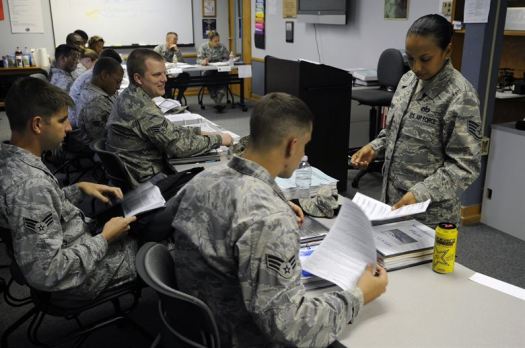
Cover image: Staff Sgt. Laura Aladdin, Barksdale Airman Leadership School instructor, mentors her flight in enlisted performance feedback and bullet writing at Barksdale Air Force Base, La., June 22. All Airmen in the Air Force must attend ALS prior to becoming NCOs and supervisors. (U.S. Air Force photo/Staff Sgt. John Gordinier)

 The Angry Staff Officer
2 Replies to “What Going Back to Tech School Taught Me About Being an NCO”
Comments are closed.