
You know the old adage, the Army is always preparing to fight the last war? I’d offer a twist on that: the Army is always preparing to fight the war it really wants. And the war it wants is World War II. Specifically, the European Theater in World War II. Hyper-specifically, 1944 WWII Europe. Minus Operation Market Garden, too messy. Also, minus the Hürtgen Forest; similarly, too messy. To paraphrase U2, the Army is stuck in a moment, and it doesn’t want to get out of it.
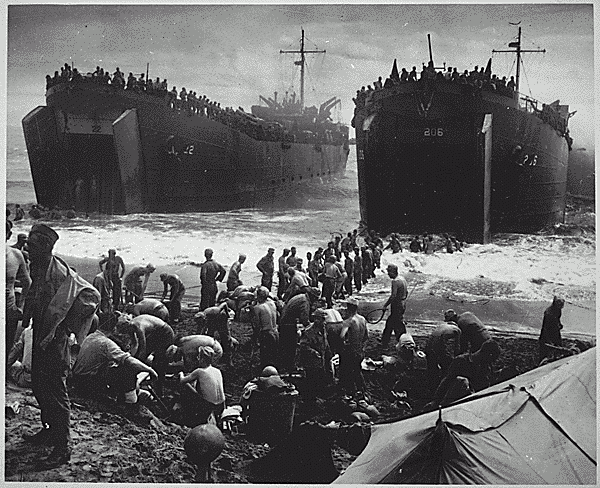
Nowhere is this made more clear than in the Army’s obsession with the June 6, 1944 landings in Normandy. Every year, the Army sends soldiers, bands, paratroopers, and all number of dignitaries to Normandy to commemorate the reduction of fortress Europe. And why not? It was an incredible achievement, brought about at great cost of life and was the culmination of years of shaping operations. Normandy has everything the Army loves: airborne operations, divisions fighting their way inland, armor busting out of encirclement, the Air Force and Navy in supporting roles, allies alongside, and the liberation of towns filled with champagne. Most importantly, it was a victory. It’s a heady mix. And it is a measure of how important this event is to Army heritage that it sends delegations to Normandy without fail, as they recently did for the 82d anniversary. No other U.S. engagements of either World War get the attention Normandy does.
Why is this dangerous? Aside from all the obvious reasons – namely, that the Army never gets a say in the war it wants to fight but has to answer to U.S. policy – focus on the European Theater of Operations offers a skewed snapshot of the brutal realities of the other theaters of the war. Given that much of the Army’s current focus is on the Pacific (at least, when the Middle East isn’t calling it back with a “u up?” text), one would think that the Pacific Theater of Operations would garner more attention. It certainly does for the Navy and Marine Corps.
But all the services tend to approach the problem with their own role, missions, and budget objectives in mind, which is a recipe for failure. As we’ll see, the Pacific defies one single service’s ability to gain victory. The U.S. joint force’s lessons from fighting across the Pacific from 1941-1945 offer critical takeaways that are far more relevant than simply wishing you could reenact “Fury” or “Band of Brothers.”
So, You Want to Go to War in the Pacific
First, a little historical background. The Pacific Theater of Operations, or PTO as I’ll call it to save some time and space, was complex on a scale the U.S. joint force could not have imagined prior to WWII. Operations ranged from the Aleutian Islands off Alaska all the way down to Australia, and then west across small and large island chains from Wake Island to the Philippines and Japan itself. The Army deployed upwards of twenty-two combat divisions into this mind-boggling expanse along with hundreds of thousands of support troops as well as thousands of pilots, flight crew, and maintainers in the Army Air Force. Throughout the campaigns that spanned the central and southwest Pacific areas, the Army and Navy found themselves in the unique position of never being able to do anything their own way. Consequently, both services found this deeply uncomfortable.
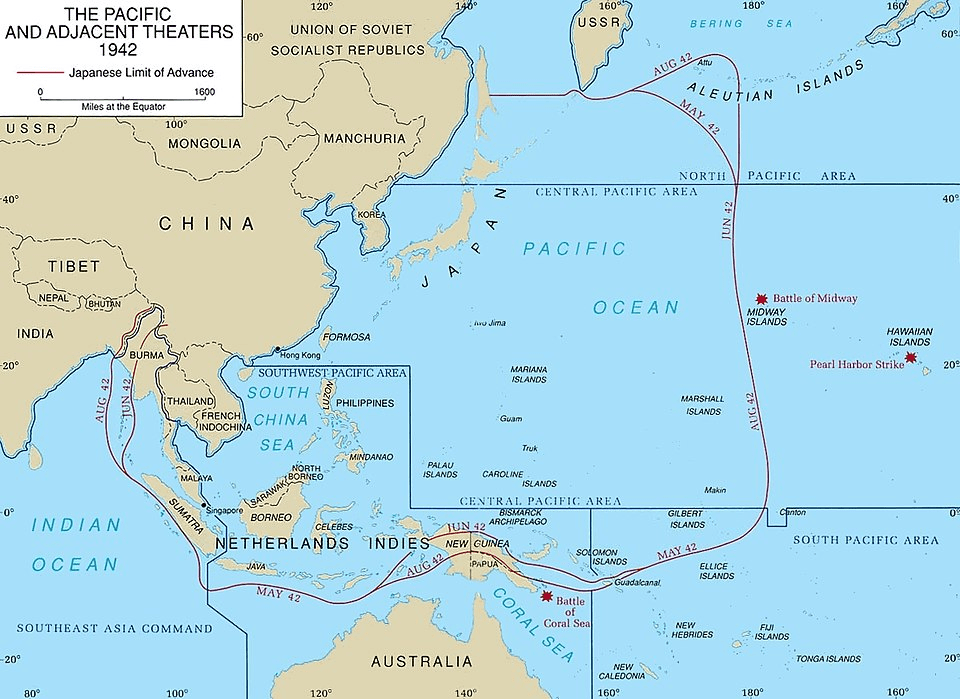
To make matters even more complex, the U.S. and Allies adopted a “Germany First” policy in 1942, committing to defeating Germany before turning on Japan. This meant that the commanders in the Pacific would be getting the leftovers from the European theater – although once the Japanese military began threatening Alaska and getting far too close to the homeland for comfort, D.C. decision-makers rapidly walked this back and sent more forces than originally allotted. Still, the PTO was always second fiddle in the war until early 1945.
And since WWII was a global war, this meant that wartime strategy was not simply dictated by Washington, but by a baffling array of varying interests. Meeting in conferences from 1942 to the end of the war, the Allied civilian and military leaders attempted to set strategic conditions and objectives for their military operations. I say “attempted,” because they spent more time trying to overcome their diverse set of interests to find a common plan than anything else. You had the U.S., which wanted to end the war in Europe rapidly to then deal with the country that gave us a bloody nose; then there’s Winston Churchill, fighting for his nation’s survival as well as trying to preserve a failing empire. Joe Stalin, never easy to get along with, spent most of the time trying to get the Allies to open a second front in Europe to relieve pressure on the Soviet Union. Then throw in two notable cranky men, Chiang Kai-Shek and Charles de Gaulle, the former trying to preserve power to take on Mao and the communists and the latter fiercely on the road for revenge, and you have a recipe for some really weird dinner table conversation. As Churchill once quipped, “There is only one thing worse than fighting with allies, and that is fighting without them.” All this to say, the ever-morphing strategic objectives sent ripple effects coursing across to the Pacific, making operational long-term planning very tricky.
This unique blend of chaos offers an environment reach in hard-learned lessons, for those that want them.
The Tyrannical Trinity: Distance, Time, and Terrain
What sets the Pacific apart from any other theater is not just its epic scale, but the fact that it is mostly water. This sounds like I’m saying something stupidly obvious, and I am. But this simplicity masks a multitude of problems. To paraphrase Clausewitz, “Everything in war is simple, but the simplest thing in the Pacific is so difficult that it makes me want to drink a bottle of brandy and pass out on top of On War.”
Everything – everything – has to move by sea. Troops, ammunition, food, medical supplies, fuel, building equipment, tanks, landing craft, furniture, tents, spare parts, tools, the list goes on and on. This immediately means you are constrained by your shipping tonnage. And not just regular cargo transports, but specialized vessels: landing craft for infantry and armor, lighters, freighters, coasters, fuelers, barges, and aircraft carriers. During WWII, shipping was the one constraint that governed all else. Availability of tonnage set the timetable for troop buildup, airbase and port construction, and all offensive operations. Landing craft availability set the operational pace for all military action. Since every single theater needed them and since the U.S. did not begin serious production of landing craft until 1942, this one item determined the strategic scope and pace of Allied operations for the duration of the conflict. And we’d be silly to think that any modern day enterprise in the Pacific would be any different.
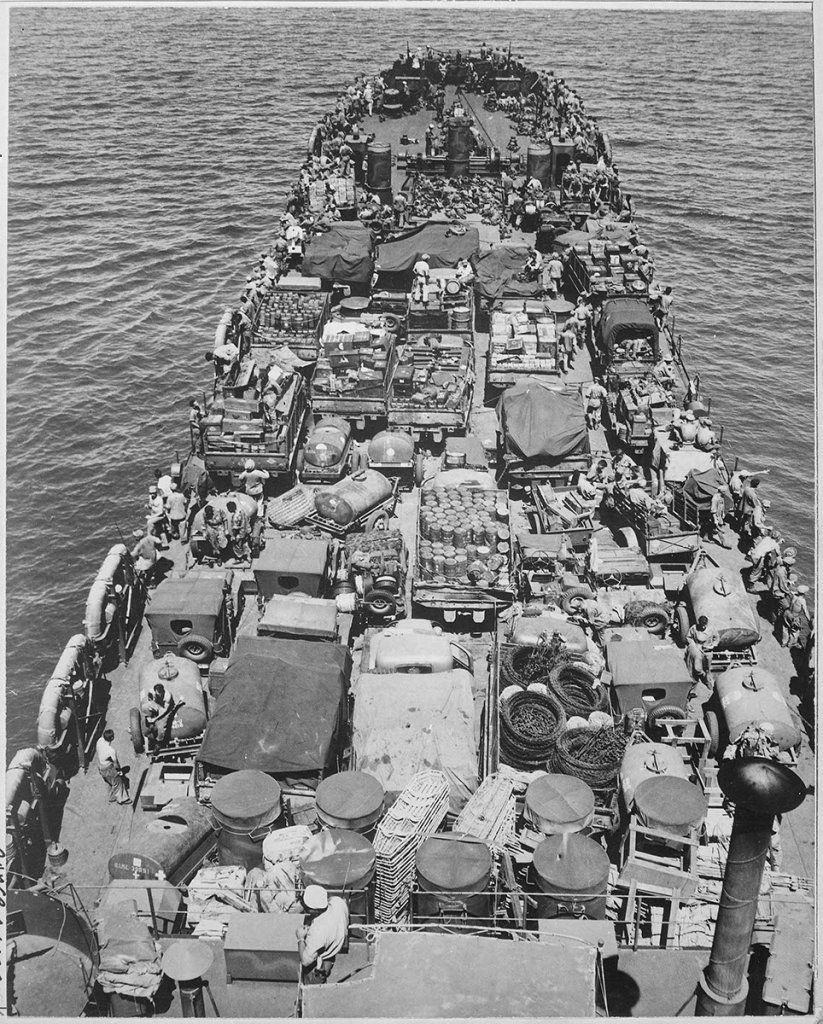
Distance took these already difficult problems and magnified them. From San Francisco to Brisbane, the distance is 7,200 nautical miles – twice that from New York to Liverpool. This problem was increased by operational success. As you island hopped, the further you hopped from your base of supply, the worse the problem became. Each lily pad (yes, in this analogy, the Army is a frog) brought you a step closer to the enemy and a step further away from your supply lines.
The tyranny of distance ensured that time would also be a key. Time ships spent at sea before they could complete their mission and return to home port to again be loaded and dispatched. Time it took for task forces to reach their objective. Time spent searching for the enemy’s main force and time spent relaying that back to commanders far from their subordinate units. Time for the enemy to react to your moves, putting troops ashore on an island where they could disrupt pre-arranged movements hundreds of miles away. And time ticking down for the patience of an American public already tiring of war and wondering why victory was not already at hand.
Lastly, the terrain of the Pacific is such that it required a series of sequential moves rather than a free-flowing war of maneuver that Europe offered. There are few large land-masses in the Pacific that can serve as jumping off points for large bodies of troops, house hundreds of aircraft, and have a deep water naval port. Thousands of small islands large enough for an airfield alone dot the central and southwest Pacific. New Caledonia, New Zealand, Australia, and the Philippines offer the best friendly support – but geography and distance make those difficult to get to from the western U.S. The terrain and conditions on the islands offer challenges for movement and survival. Mountains, jungles, and marshes slow movement to a crawl. Torrential rains turn roads to a morass while baking sun requires significantly more water intake per person. Humidity rots clothes and rusts engines, requiring more uniforms and more spare parts, requiring more shipping. The cycle is incredibly vicious.
Ace of Base(s)
The path to victory in the Pacific comes to those who can mass more capabilities in key positions than their adversary and maintain them. Therefore, the path to victory comes via logistics. Ports and airfields are the key weapons in this war. Ports are fundamental because they not only enable forward repair/rearm/refuel sites, but they also serve as cargo depots to stockpile resources to assist with onward movement. Airfields are vital for protecting the port and installations built up around it, as well as for flying in additional supplies and troops.
The problem, of course, is that most of these are not naturally occurring in nature. They must be made. This first requires security, on the sea, in the sky, and on the land. Naval and air forces form a protective canopy as ground forces go to work securing the island, establishing air and sea defenses, and then beginning construction of port and airfield facilities. This entails a significant number of construction troops, air defense units, and long-range artillery.
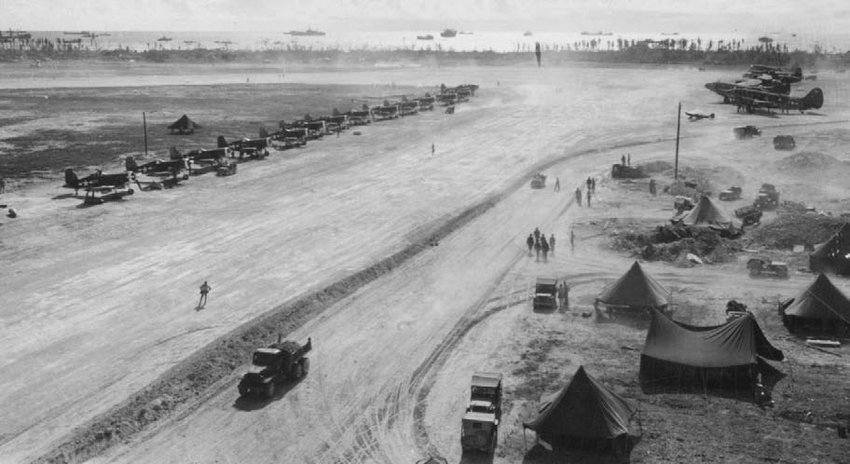
The location of these bases need to be close enough to be a power projection platform, but far enough away from the enemy’s capabilities to significantly damage the bases once completed. Redundancy allows you to take losses at the forward edge without losing the initiative due to loss of capabilities. Losing multiple carriers in 1942 caused U.S. forces to look for islands to consolidate airpower, leading to fighting in the Solomons as the Japanese contested U.S. moves. U.S. forces were able to build up enough combat power to check the Japanese counteroffensives and set them on the defensive.
Sometimes the Force You Want Isn’t the Force You Need
“You go to war with the army you have, not the army you want,” is the famous Donald Rumsfeld quip that routinely gets rolled out. Like it or not, he’s right. The lead time for force structure and equipment modernization usually happens 2-3 years before the given conflict, because reality keeps imposing pesky constraints like time and resources. The Army, Navy, and Air Force all have to keep this in mind; the latter two, because they think they can do it all without the former, and the former, because it often only thinks in terms of brigade combat teams.
So, what does the PTO of WWII tell us the joint force is going to want in a Pacific conflict? Sure, a limited number of combat brigades will be needed initially to seize and hold terrain. More brigades will be needed pushing to larger islands. Divisions finally got to fully maneuver in corps formations by 1945 on Luzon and Okinawa. But prior to that, most actions were small unit jungle fights, constrained by terrain. Divisions selected for 6th Army’s Luzon invasion conducted retraining in large-scale maneuver warfare in late 1944, even though they were composed of combat-tested veterans. So yes, combat units matter, but not at the level the Army likes to imagine.
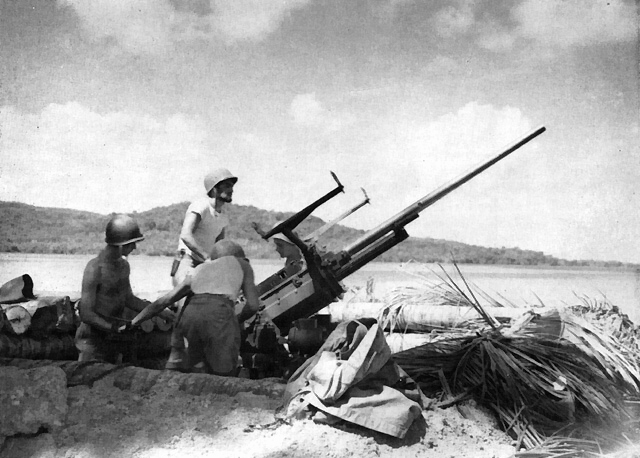
What the joint force will need for any fight in the Pacific is a metric crap-ton of engineers, transportation units, and logistics officers. Especially engineers. They’re the ones who will reshape the landscape to permit the Navy to refit and who will give the Air Force a place to land. Additionally, air defense and long-range fires units will be required to provide a canopy of protection over each of these bases. Signal units will be needed so that everyone can talk past each other, I mean, talk to each other. Disease played hell with all services in the PTO, so medical units will be a vital necessity. This requires a heavy lift – literally – to move all these personnel and things into position, to sustain them, and to keep them safe.
If you want to go to war in the Pacific, then, you are going to need an Army that looks a little different than the current Transformation force.
Who Owns What?
Once you’re in place, the logistical headaches are just beginning. Suddenly you have a supply chain with a million links. And at the heart of the matter, who owns the command authority for what, and when, and also where? Does the Army’s begin when the Navy and Air Force land things, and vice versa? During amphibious assault landings, does the Army take over management of logistics once they have a beachhead or once they leave the boats? And does anyone in any of the services understand the requisite needs, requirements, and procedures of all the others? Joint logistics has entered the chat, and it is not going to leave.
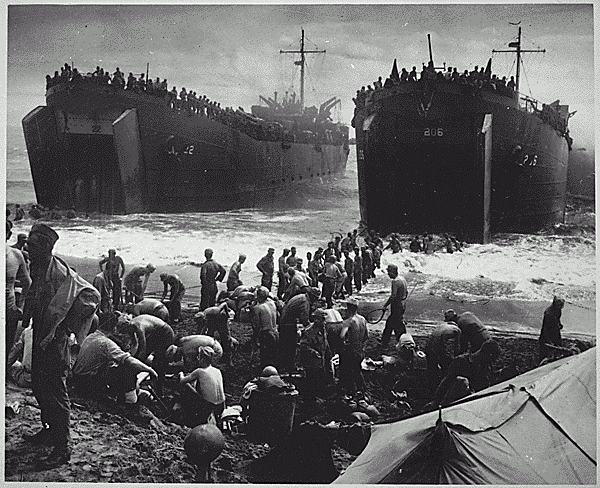
During WWII, land and sea supply routes became one of the largest bones of contention for joint commanders. Adm. Nimitz commanding in the Central Pacific left it up to his subordinate theater commanders, who typically handled it in whatever best suited them. It took years to establish a somewhat coherent system of supply that didn’t involve massive duplication of effort and wastage. See my earlier comment that logisticians are going to be in massive demand, by everyone. Winning may look like whoever figures out the best supply system first.
It’s Dangerous to Go Alone
By this time, I hope you’ve realized that winning in the Pacific – nay, surviving – must be a fully joint endeavor. No one service can do this on their own. No two services can do it on their own. It requires a level of jointness that is downright unsettling. Since nearly everything depends on naval and air superiority, and since those require secure, well-maintained logistics bases, we can see the logic of cause and effect dragging reluctant service adherents to the resulting conclusion.
The Pacific is a joint fight. And if you can’t figure that out, the environment and enemy will punish you for it. When the Navy commander managing the campaign to retake the Aleutians in 1942 couldn’t work well with his Army counterparts, the campaign stagnated and he was relieved. The Marines are still bitter about the Navy withdrawing off Guadalcanal after heavy losses, briefly abandoning the 1st Marine Division without supplies or reinforcements. Marine Lt. Gen. Holland Smith damaged Army-Marine relations when he relieved 27th Division commander Maj. Gen. Ralph Smith on Saipan in 1944 – a conflict that still angers parties on both sides to this day.
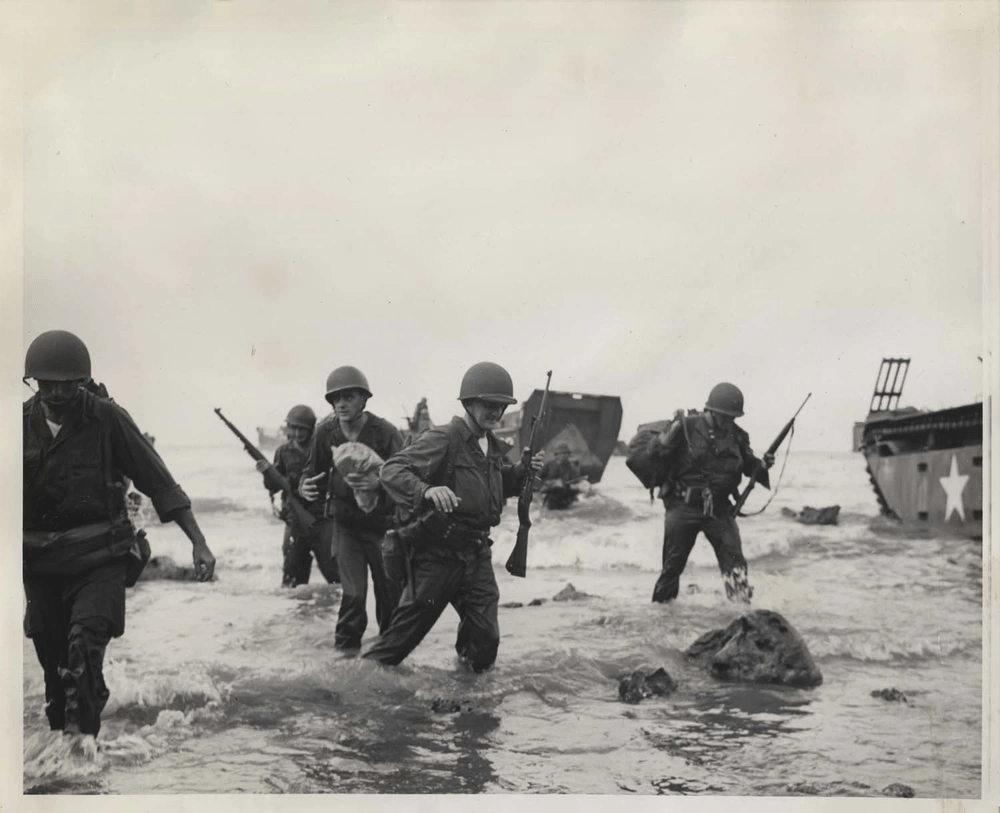
To be a good joint commander is a difficult job. It means not only subordinating service rivalries and jealousies, but recognizing systems and individual talent that can benefit the whole fight. No single commander in the WWII PTO embodied this, but aspects of it can be seen in Nimitz, Halsey, and – in very small doses from time to time -MacArthur.
The Pacific is a big place, and success requires partners and allies. The U.S. in WWII was beyond lucky to have the immediate assistance and sometimes suicidal heroism of our Australian and New Zealand partners. The UK and Canada, too, served alongside U.S. troops both in the Pacific and in the China-Burma-India Theater. Hundreds of thousands of Pacific Islanders risked their lives to gather intelligence, run supplies, and pass communications for U.S. forces. So too did the people of the Philippine Islands, who – although occupied since 1942 – held out resolutely until the return of U.S. forces in 1944-1945, weakening the Japanese in the interim with guerilla raids. And of course, Nationalist China, which held down the predominant part of the Imperial Japanese Army on mainland China for seven long years. If we want to succeed in the Pacific, we must have friends, partners, and allies.
So, what now? Do we throw up our hands and say, “Too hard! Too much to think about! Back to a map of Europe where we can maneuver tanks like the good ol’ days!” That certainly seems to be the attitude of many. Others prefer to over-simplify the problems and speak in vague notions of fighting across the island chains while ignoring the Tyrannical Trinity.
First, acknowledge the problem set. Then figure out ways to overcome it. Doing this for any theater the Army will be involved in is never a bad place to begin. Because of the joint nature of the fight, a “if this, then this,” model while working backwards form the intermediate or immediate objective at least gets you to knowing the type of force structure you would need.
Second, admitting that this stuff is hard and that it comes with significant costs should be communicated to the policymakers who have important decisions to make. Global strategy requires long range planning with important decisions. Landing craft production in 1941-1942 didn’t catch up to requirements until late in the war, pushing timelines for most operations to the right. Determining the modern-day equivalent to the landing craft conundrum would be a good start to any problem solving.
Third, resist knee-jerk reactions to make continuous alterations to force structure and equipment design. This is hard to do, as we always want to be making tweaks based off current lessons learned. But unless we’ve got forces going into combat tomorrow, those “current” lessons will be old news by the time we deploy the unit. So, what changes make sense based off larger trends? What equipment has the longest lead time in production? Can we substitute mass and volume over “exquisite” capabilities? Do we have units that can function in any environment rather than being tailor-made for one specific one? And do we, as the Army, have enough of the type of units the joint force would be asking for? Answers to these questions help us field a more effective force for the future.
Lastly, none of this is a fix-all. Training still matters. Mindset still matters. Plans still matter. And all this needs to happen in a joint, allied environment before the missiles start flying. As Taylor Swift said, in her famous treatise on how to win in the Pacific, “Keep it one hundred on the land, the sea, the sky.”
For more reading on this topic, I highly recommend John McManus’ Pacific trilogy from the Army perspective, and Ian Toll’s Pacific trilogy from the Navy perspective. Both the U.S. Army Center of Military History and U.S. Naval Institute Press have excellent publications on these topics.
Enjoy what you just read? Please share using the buttons below.


One Reply to “”
Comments are closed.