

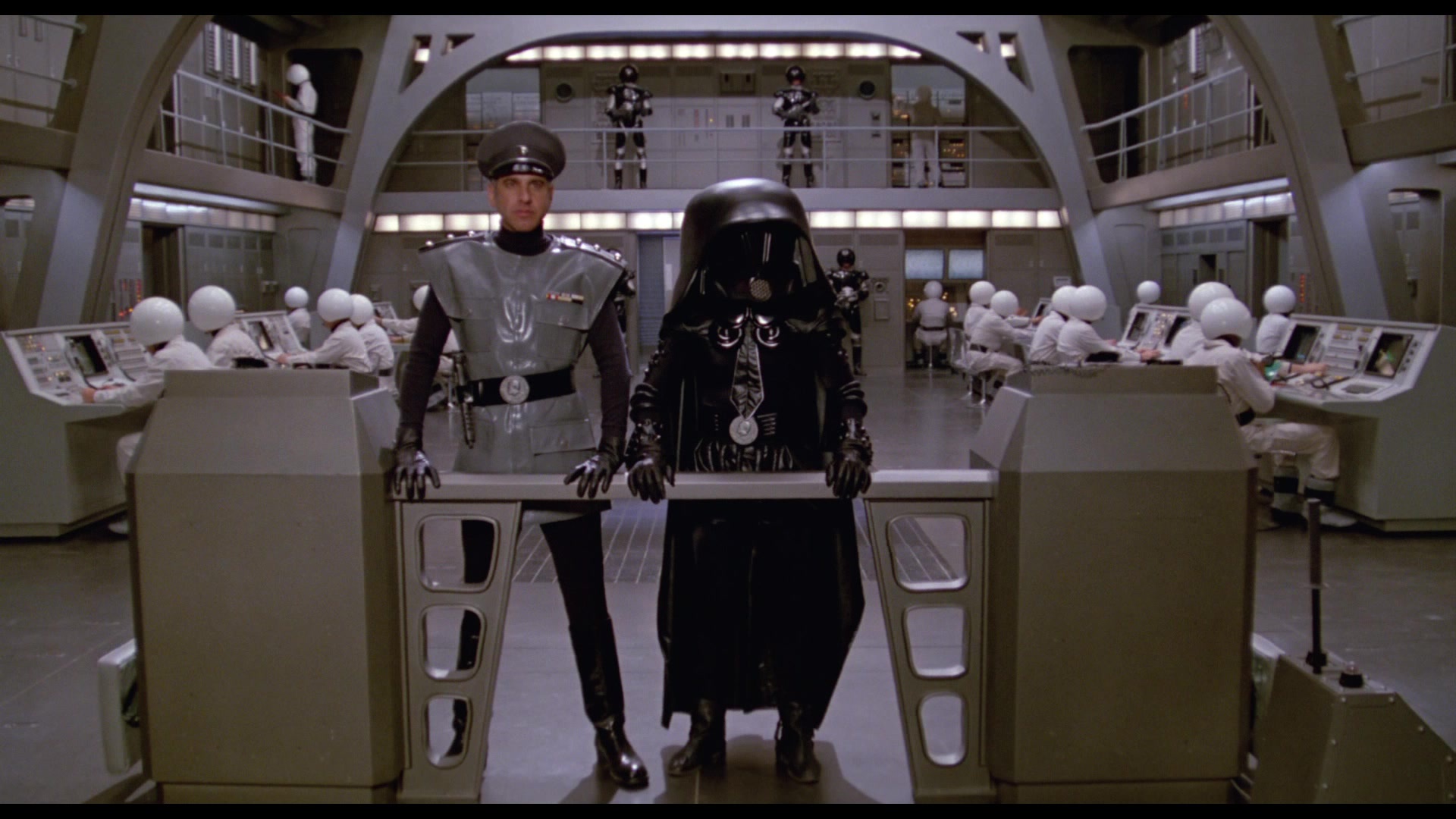
Editor’s note (with apology built in): Reader, if as you peruse the following, you wonder whether the author is sick in the head or does not understand FM 6-22 but at all, rest easy. This, but for the negligence and oversight of the editor, should have run on the 1st of April, the day of Fools. Alas, the fool of the editor biffed it. He shall be justly punished. And now, back to the article at hand.
Parodies are almost always better than the original. Galaxy Quest and The Orville are both better than Star Trek, Hot Shots! and Hot Shots! Part Deux are greater than Top Gun and Rambo: First Blood Part II, respectively, and “Weird Al” Yankovic improves on the work of every artist from whom he lifted material. And even one of the most popular intellectual properties in history is not immune to this phenomenon. The following will come across as pure blasphemy to readers of this site, but sometimes there is no good way to air the truth: Spaceballs is clearly superior to Star Wars. Even Joseph Campbell himself would agree his “Hero’s Journey” is better exemplified by Lone Starr than of Luke Skywalker. Dark Helmet is a much more intimidating villain than Darth Vader, Barf is a more understandable sidekick than Chewbacca, and Yogurt, unlike “Master” Yoda, did not fail to see the merchandising juggernaut that was in his galaxy far, far away. It is, after all, “where the real money from the movie is made.”
But this claim of superiority does not end there, as the true merits of Spaceballs lie a little deeper under the surface: Spaceballs is a movie about Leadership. True, insightful lessons of positive leadership can be found within this film, and for those who have served in the military, these lessons are all too clear. In fact, the movie aligns quite nicely with the leadership attributes and competencies found within Army Field Manual (FM) 6-22, Developing Leaders, as they are all contained within Mel Brooks’ 96-minute masterpiece. So let us go on a journey to another galaxy, at ludicrous speed of course, and take in some amazing lessons from some of the most effective fictional leaders ever to grace the silver screen.
And if you can read this, you don’t need glasses.
Character
Leaders perform selfless service. As one of the Army Values, selfless service is about putting the needs of your organization and others before your own. After Pizza the Hutt’s untimely death, Lone Starr realizes they no longer needs the million spacebucks earned from their rescue of Princess Vespa. King Roland discloses “He only took $248 spacebucks for lunch, gas, and tolls.” Even though he got the princess in the end, risking your life against Spaceballs for only $248 spacebucks is basically the textbook definition of selfless service.
Leaders support equal opportunity. All personnel should support equal opportunity programs, especially leaders, which in the military means not discriminating against others based on such factors as national origin, race, sex, or religion. After rescuing Princess Vespa and Dot Matrix, and seeing Lone Starr’s disdain for Druish princesses (royalty is not a protected category), Barf responds with “Funny; she doesn’t look Druish.” Barf clearly treats all people with dignity and respect, Druish princesses or otherwise.
Leaders always seek a higher purpose in their goals. While effective leaders can clearly articulate their task, purpose, and endstate, their overall mission needs to have a greater significance than just completion. After Barf ebbs at the dangerous rescue mission, Lone Starr chastises him by saying “We’re not just in this for money,” reinforcing that they are doing it “for a shit load of money!”
Leaders have a “people first” mindset. Although the mission needs to be completed, leaders need to care for and support their subordinates who are part of their organization. King Roland of Druidia exemplifies this mentality, pleading, “Lone Starr, you have to help me. Please, save my daughter. She’s being attacked by Spaceballs.” Even though he is “people first” and asks them, “Please, bring her back safely,” he also supports property accountability, adding, “And, if it’s at all possible, try to save the car.”
Leaders are nice. I have heard this described before as the Road House theory of leadership: Be nice. The computer on Spaceball 1 subscribes to this theory, announcing “Thank you for pressing the self-destruct button,” and, after reaching “1,” follows with “Have a nice day.” The Spaceball leadership, clearly adopting this theory after seeing it in practice, responds in unison with “Thank you.”
Presence
Leaders maintain peak physical fitness. Whether you are on the line or on staff, military leaders must be in excellent physical shape to endure the rigors of combat. Exhausted following a full sprint to the bridge, President Skroob remarks “This ship is too big. If I walk, the movie will be over.” He knew the physically demanding task and had the requisite level of fitness to accomplish it, while at the same time setting a positive example for crewmembers.
Leaders project confidence. Even in the direst of situations, leaders need to be confident in their decisions and their organization, which in turn imbues their subordinates with confidence. After Dark Helmet seemingly defeats Lone Starr, he quips, “So, Lone Starr, now you see that Evil will always triumph, because Good is dumb.” Project confidence in everything you do… even when you are wrong… especially when you are wrong.
Leaders practice resiliency. Servicemembers need to develop and possess the ability to bounce back from experiencing hardship. John Hurt, even after having a xenomorph burst through his chest in Alien, manages to still bounce back for a second round at the end of Spaceballs, exclaiming “Not again.” This topic is also covered earlier in the movie, where Dark Helmet tells Lone Starr to “Say goodbye to your two best friends, and I don’t mean your pals in the Winnebago;” he is clearly talking about the importance of both resiliency and having a support system.
Leaders maintain security. It is imperative for leaders to enforce both physical and operational security. After hearing the combination for Druidia’s air shield, Dark Helmet remarks, “That’s the stupidest combination I’ve ever heard in my life. That’s the kind of thing an idiot would have on his luggage.” This comment not only shows his deep concern for physical security, but is prescient when later told to change the combination on President Skroob’s luggage.
Leaders protect their subordinates. Whether it is a safety brief before a long weekend or telling their team to take cover in combat, leaders look out for their subordinates and do their best to protect them from physical or emotional harm. In the opening scene, Spaceball 1 propels across the screen, with the audience seeing a highly visible bumper sticker on the rear of the ship: WE BRAKE FOR NOBODY. Possibly having reviewed force protection methods from US Army convoys during the Global War on Terrorism, this is a clear indicator the Spaceball 1 Command Group cares deeply about the safety of their subordinates and the protection of their ship, even to the extent of potentially putting other ships at risk.
Intellect
Leaders remain alert. They need to be in an attentive state which supports the receiving, processing, and understanding of information in order to make informed decisions. After a visit to Mr. Coffee, Dark Helmet informs the crew, “Now that I have my coffee, I’m ready to watch radar.” He not only wants to be in the right condition to take in the information from Mr. Radar, but also is reinforcing that coffee, Monster, and Zyn should be their own class of supply.
Leaders practice safety first. And they incorporate safety in everything they do. Before jumping to ludicrous speed, Colonel Sandurz confidently briefs the ship on the protocols. “Prepare ship… prepare ship for ludicrous speed. Fasten all seat belts, seal all entrances and exits, close all shops in the mall, cancel the three-ring circus, secure all animals in the zoo…” It is no coincidence the only individual who gets injured during this maneuver ignores these safety protocols, receiving a likely traumatic brain injury in the process.
Leaders do not rely on technology. Technology is a crutch and leaders need to be able to “go analog” when the situation requires it. After locating the cancellation button for the ship’s self-destruct mechanism, Dark Helmet exclaims “Out of Order? F@#$! Even in the future nothing works.” Leaders are adaptable and don’t let technology (or lack thereof) keep them from accomplishing their mission.
Leaders understand the adversary. A former senior rater once told me that “You need to know the enemy so well you understand how they view the world.” The inhabitants of the Planet of the Apes clearly understood this, proclaiming the following on seeing their visitors. “Spaceballs? Oh, shit. There goes the planet.” After foolishly squandering their precious atmosphere on Planet Spaceball, they likely would have eventually done the same here.
Leaders are experts and professionals. Amateurs study tactics; professionals study logistics. Upon hearing warning sirens going off on Eagle 5, Barf calmly and collectively deduces the problem: “I don’t know. I don’t know. We’re losing power. Why? ‘Cause we’re outta gas.” Leaders use this expertise to determine the solution to a difficult problem and calmly execute the required actions to overcome it.
Leads
Leaders do so by example. Subordinates will look to your example when making their own decisions. After giving Princess Vespa his coat and asked if he would be cold, Lone Starr brazenly replies, “Nah, cold never bothers me,” hiding his shiver from her. If you refuse to put on your cold weather gear, you project strength and confidence, and your Soldiers will heed your example by stubbornly refusing to don theirs as well.
Leaders show strength by providing unpopular (but necessary) recommendations. As a staff officer, it is your duty to provide your commander the risks associated with the proposed course of action. After given an order to increase speed, Colonel Sandurz replies with, “Ludicrous speed? Sir, we’ve never gone that fast before. I don’t know if this ship can take it.” It shows courage and expertise to provide difficult recommendations, but the ultimate decision to accept those risks is on your commander.
Leaders recognize when their subordinates need a rest period. Good leaders know when their subordinates are being overworked, and therefore are responsible for providing them time to relax and unwind. After being told they had dropped from ludicrous speed, a potentially concussed Dark Helmet says “Good. Well, why don’t we take a five-minute break.” Good leaders recognize when Soldiers need a well-deserved respite or an overall decrease in Operational Tempo (OPTEMPO).
Leaders identify subordinates in need. Engaged leaders should be able to recognize when a subordinate or colleague is not acting quite like themselves, which allows them to approach the individual and provide appropriate resources for their situation. After being told by his radar operator that he has lost the bleeps, sweeps, and the creeps, Dark Helmet whispers to Colonel Sandurz, “That’s not all he’s lost.” He not only identifies a subordinate with potential mental health concerns, but he shows discretion is keeping the issue only between himself and hist first officer. There is most certainly a deleted scene where Dark Helmet provides the operator additional resources to support their mental health; a scene which made the cut still gets after this though, where during the aforementioned alien encounter, a man at the bar yells, “Water my ass! Get this guy some Pepto Bismo!,” clearly taking care of another by anticipating their needs.
Leaders communicate good… or well… you know what I mean… they are good at communicating well. Leaders must be good communicators to succeed at their position. This is expertly displayed during this dialog between Colonel Sandurz and Sergeant Rico:
Colonel Sandurz: “What is it, Sergeant Rico?”
Sergeant Rico: “You told me to let you know the moment Planet Druidia was in sight, Sir”
Colonel Sandurz: “So.”
Sergeant Rico: “Planet Druidia is in sight, Sir.”
Colonel Sandurz: “You’re really a Spaceball. You know that, don’t you?”
Sergeant Rico: “Thanks, Sir.”
In this passage, there is excellent communication between both leader and subordinate, with Colonel Sandurz reinforcing this behavior and acknowledging positive performance.
Leaders provide clear guidance and direction. Clearly articulated orders are necessary to facilitate understanding and enable appropriate action by subordinates. When approaching Princess Vespa’s Mercedes, Dark Helmet tells his gunner to “fire a warning shot across her nose.” He later clarifies this order by asserting “I said across her nose, not up it!” Always provide clear and concise guidance, but if not fully understood, follow it up with additional direction to ensure compliance.
Leaders respect the chain of command. It is important to always communicate through your chain of command, and no one understands this more than Sergeant Rico. After properly relaying the above information to his immediate superior, he then jumps his senior rater to tell President Skroob. Dark Helmet calls him on this error in judgement, uttering “What? You went over my helmet?” Stammering, Sergeant Rico replies, “Well, not exactly over it, sir. More on the side. I’ll always call you first. It’ll never happen again. Never, ever!” The lesson is to never jump your chain of command, especially when your immediate supervisor wields the Schwartz (even if it is the downside).
Develops
Leaders practice self-development. Professional self-development is key to leaders maintaining their proficiency and sets a positive example of self-learning to subordinates. Even when President Skroob is spending time with Marlene and Charlene in bed, he continues to read to professionally develop himself (albeit with an upside-down book).
Achieves
Leaders follow orders from their higher headquarters. As long as they are not illegal, immoral, or unethical, leaders execute orders from their higher headquarters. While on the sands of Vega, Dark Helmet is given a clear and direct order from his higher authority, President Skroob: “Tell him to comb the desert. Do you hear me? Comb the desert!” When questioned by Colonel Sandurz about the possibility they are being too literal in their interpretation of their orders, Dark Helmet quickly retorts with “No, you fool. We’re following orders. We were told to comb the desert, so we’re combing it.” Dark Helmet knows this to be a valid order, and thus executes it with ruthless efficiency (even though they didn’t find shit).
Leaders practice property accountability. Leaders need to ensure themselves and their subordinates are accountable for their issued and signed for equipment. Princess Vespa articulates this perfectly on the sands of Vega, where she firmly declares “It’s my industrial strength hair dryer, and I can’t live without it!” While you can probably live without most of your issued gear or the equipment on your sub-hand receipt, you still don’t want to get a statement of charges for it.
Leaders conduct rehearsals. Before the operation, whether it is a Combat Training Center rotation or a physical readiness training session, leaders conduct rehearsals so their team understands the plan, can execute it accordingly, and prepare for potential contingencies. After interrupting Dark Helmet’s wargaming session, Colonel Sandurz pleads, “No, Sir, I didn’t see you playing with your dolls again.” Conducting rehearsals is nothing to be ashamed of though, and Colonel Sandurz should be proud that his commander is taking the time to look at how a situation with our heroes might play out.
Leaders conduct retraining. For organizations that do not meet the standard, they need retraining to become proficient in the task. After failing to properly transport President Skroob to Central Control, Commanderette Zircon, intent on retraining her crew, declares, “We’ll beam you back, Sir.” While President Skroob preferred to walk, Commanderette Zircon was trying her best to close out the Spaceball 8-step training model.
It is plain to see that Spaceballs is more than just a parody. As hopefully articulated above, the movie is about heroes and villains demonstrating leadership attributes and competencies within each of their spheres of influence. Lone Starr shows exceptional character as an example to his small team, while Dark Helmet displays commanding presence and a brilliant intellect. Colonel Sandurz shows the ability to lead through communication and building trust, while President Skroob makes self-development a priority. Lastly, Princess Vespa and Commanderette Zircon both get results, showing the ability to achieve with property accountability and establishing a retraining plan, respectively. If you simply look past the jokes, gags, and profanity, you would be able to see just what an amazing movie this is for developing leaders. In fact, this movie would make a great addition to our next SLDP (Spaceball Leader Development Program). Thank you for reading, and please look forward to future articles on Counterinsurgency Operations in Footloose, Multi-Domain Operations in Back to the Future II, and Counterproductive Leadership in Moana. May the Schwartz be with You!
About the Author: Major Robert A. Calkins is an officer in the United States Army and currently serving as the Deputy G2 for the 101st Airborne Division (Air Assault) at Fort Campbell, KY. He has previously served as a Brigade S2 and Committee Chief for the Military Intelligence Captains Career Course, as well as Executive Officer and Operations Officer for the 309th Military Intelligence Battalion. He wrote this article as a gift and show of respect to a friend, who loves Star Wars, yet for some reason loathes Spaceballs.
The views expressed are those of the author and do not necessarily reflect the official policy or position of the United States Army, the U.S. government, or that of Planet Spaceball.

 The Angry Staff Officer
You must be logged in to post a comment.